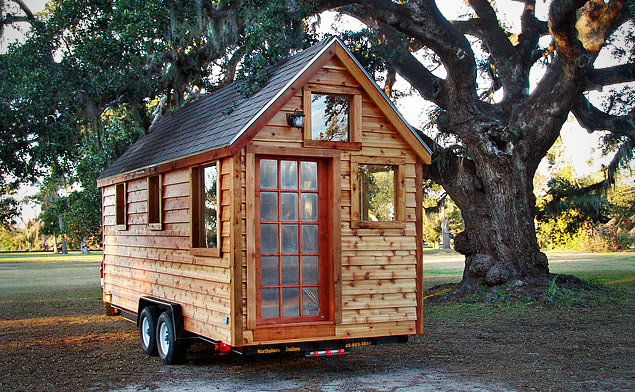
So I have recently discovered Julie Martin with Lodge on Wheels (thanks to Steph) and am hoping to talk to her soon about including her in my documentation of the Small House Movement. While scouring the internet for more information about her, I found that she actually contacted Jay Shafer and they worked together on a design for LoW and have a licensing agreement for the Gulf Coast model for people affected by the hurricane. In case you haven't read any of the stories on her, she worked restoring historic homes in Mississippi, and actually lived in the oldest home on the Gulf Coast (built 1787) until it was destroyed in Hurricane Katrina. After the hurricane, she decided it was more important to work on building small houses that she saw were desperately needed by the people around her (and herself).
While reading about this woman and in addition to doing research for my own project, I started wondering more as to where all these houses were. We've been hearing now about Marianne Cusato's Katrina Cottages for years, but where are they? We're inching in on 4 years since the hurricane, but the only coverage I've seen of houses built in New Orleans have been by Habitat for Humanity. Apparently, not one Katrina Cottage has been built in New Orleans or Louisiana in the two years since the $75 million grant was awarded by FEMA to provide homes for those displaced by Katrina and Rita. BUT, in Mississippi, thousands of cottages have been completed with their $281 million grant. You might be wondering how that could be, and no doubt, Jay Shafer was right about this one: "Mississippi was able to avoid lengthy and complicated environmental regulations by putting their homes on wheels."
A couple of weeks ago, I visited Jay Shafer at his home in Sebastopol. The line above comes from the interview I did with him and absolutely cracks me up. What follows is a bit of writing I did about the trip and includes several quotes from my interview with Jay.
Driving into Sebastapol, it’s hard to believe that THIS is in Sonoma County, home to the liberal elite, where the wine flows like water. Eccentric, funky, ramshackle shops line the highway driving in: The Sensuality Shoppe, Horses and Things, Midgley’s Country Flea Market. As I turn off the main road, the little yellow arrow on the GPS is confused by the address and seems to be having trouble figuring out how to direct me to a little house on wheels in the middle of an orchard. Eventually I turn down a road that seems like it might lead somewhere and see the little chapel-type window peeking out between the cluttered country houses.
I pull over behind the recognizable Vardo, Jay’s gypsy wagon. Next to it is a beat-up pickup truck with what appear to be orange barnacles lining its sides. A fairly large house (at least by comparison) is a distance away on the left and a matching gray cottage is beside it, just beyond the gypsy wagon and truck. Off to the right is Jay’s little wooden house, crutches leaning against the wall of the tiny two-feet-deep porch. I seem to be in a junkyard…of houses. The ground is wet as we walk up to the house, and as we take off our shoes on the porch, Jay opens the door.
Very early on, I was living in the cab of a truck in the backyard of my parents’ place. Just because we were building a house and my room hadn’t been build yet, so I would sleep in the truck. So that was my first tiny house…What came next was my trip to Tokyo. And that was a very brief experience where I stayed maybe five days in Tokyo itself. And lived in, well, I went out there with just $250 or less, and these Iranians show up at the airport and are like “here’s a room for just $40 a night.” And I thought that was great, so I spent a lot of time in my room just being inspired by the 4-foot by 4-foot bathroom. That’s where I spent my vacation, in the bathroom, looking at the dimensions of the bathroom and how they fit a shower and bathtub and a toilet and a sink all in one little 16-square-foot room.
I soon find out that the truck outside was his home for more than a year. The orange barnacles are spray foam insulation to keep the drafts out. For almost 10 years, Jay has been living in the smallest spaces possible. He grew up in Mission Viejo and hated the large house his parents lived in.
I think I was already leaning in the direction before I went to Tokyo because I was aware that bigger spaces were a big waste of energy just because I had to clean my parents’ house when I was a kid.
I’d been in art school for a while and learned from my favorite professors… that composition in art is always about what is necessary, and eliminating everything else. If it’s not contributing to the composition, it’s weakening it. So I just figured that the same thing goes for every work of art, and every life. If it’s not contributing, it’s weakening.
Sitting here now, from my perch on the metal desk/counter that spans the length of the front room, it is clear that he succeeded. The blue flames are shivering in the little propane boat heater on the wall. Jay sits next to them in an ivory cotton IKEA chair. Beside him, his wife rests in an identical chair. Her foot is perched on his chair, and his hand rests gently on top of it. They smile sweet, quiet smiles and seem to have absorbed those small, glowing flames. There is a contentment here, a peace of two people living with what they have.
I like to say that there is no black and white and green, just a way of paraphrasing what my friend Treithan always says which is that you can’t really diss people for this or that. You know, I had a landlord once who was a pseudo-hippie and would come out and search the recycling bin and the trash can and make sure that I didn’t throw one piece of paper away. That doesn’t win over anybody, the eco-nazi thing—you just gotta show people the positives of living well.
So WAY back in October, I was in Texas for a friend's wedding and made my way over to Luling to interview Brad Kittel. I would love to post some excerpts from the hour-long interview I did with him, but the truth is, I haven't even listened to it. Chances are that I won't get around to it for a while yet. But since I've finally gotten around to editing a lot of these, here are some of the photos of the Tiny Texas Houses and the man himself.
The thing that sets Tiny Texas Houses apart from a lot of other small houses is their use of almost exclusively reclaimed materials. Brad Kittel has worked in architectural salvage for many years and has people calling him from all over the country with leads on buildings which are soon to be destroyed.
In 2006, Kittel began building little houses with these materials he'd spent years and years gathering together. I have friends and family who had visited his Discovery Architectural Antiques in Gonzales long before Tiny Texas Houses was born.
When I interviewed him, Kittel said that essentially he has a short attention span. He gets going on something and gives it his all until he is able to turn it over to other people. In a very short amount of time, he has been able to put together one of the biggest tiny house companies around.
The project that Kittel has his sights on now is a tiny-house village. He wants to give workshops where people come out to an area right by the warehouse and learn to build a tiny house from the ground up. The houses would stay on site and eventually be sold to residents to live in on site. Chapels, stores, a post office, etc. would follow. When enough people were living there (I believe the magic number was 40), then the residents could vote to be declared their own township. If this went through, then the town's residents could vote on which building codes they wanted to follow, thereby releasing tiny-house building in that area from the myriad restrictions that new homes have to follow almost anywhere else.
Kittel comes across in many ways as a mad Texas scientist. His Stetson hat, round wire-rimmed glasses, tan skin and gaunt figure combine to make a really interesting man that you wouldn't expect to be building houses.
He has grand plans about how the small house movement will play out, and he mostly hopes to be a catalyst who enables the momentum to grow. Ideally, he'd like to have warehouses in every state that gather salvage material so that nearby residents have the ability to find and drop off reclaimed materials for building. Kittel uses dirty words like "barter" when talking about the ideal scenario for enabling others to build by donating time and energy to gain materials and knowledge.
Many people would be surprised to learn that Kittel doesn't live in a big, or even small, house with the money he's made on these houses. He tries to reinvest as he goes back in the business. In fact, Kittel lives in a small apartment in the warehouse for Tiny Texas Houses.
If you're not paying close enough attention, Brad Kittel can definitely come off a bit like a snake-oil salesman, until you realize that the main thing he's getting out of it is the knowledge that he's opened someone else's eyes to what is tiny, and possible.
Before I graduated high school, I had already redecorated my room several times. At 15, I could no longer stand the hippie aesthetic of the painted "peace" coffee sack and teal green walls. I decided I wanted my room to be a dark moody blue, the exact color of a patch of rain clouds I had seen creeping up that summer on a baseball stadium. I felt that if my soul were a color, it had to be this one. My mom was wary of so much dark blue so we compromised on two white walls and two blue walls. I had also planned to paint a large quote above one of my windows (blue on white) with my favorite quote, by Socrates: "There are but two tragedies in life: one is not to get your heart's desire, the other is to get it." I was a rather introverted teenager and spent much time writing poetry. To me, this room was a sanctuary for music and written words.
Psychologist E. Prelinger said that "as a person's self-image changes, he or she is able to put away or dispose of objects that no longer reflect who they are, and acquire or make others." For four years in college, I lived in a condo my parents had bought in Austin. About a year into my life there, the bedroom walls became silver metallic.
I put a string of white lights up around the ceiling and lanterns hung above the head of the bed. A single chest of drawers of pale, smooth birch wood nestled in the corner and a soft ivory shag rug lay at the entrance to the room and matched the soft ivory blanket on the bed.
It was like sleeping in a soft, ethereal, metal jewel-box. As I got older, the celestial blue and silver no longer seemed to reflect who I was. After a tumultuous season of unrequited love, I painted the pale living room walls a passionate deep red. The kitchen walls adjoining it became a bright happy marigold. The change was exactly what I needed, but eventually I had to leave.
Over the next few years, I continued to tire of the pale and artificial. My love of birch gave way to naturally imperfect and dark brown woods. My curtains were pink raw silk, blanket pumpkin-colored, tables the color of dark tobacco stain. The last bedroom I painted was the color of dark chocolate, with dark brown pillows to contrast against that first ivory blanket.
Every year, I moved somewhere new and redefined myself in the space surrounding me. One year I was bright and fun. The next year, dark and sophisticated. Finally, I moved to California and found a place that was most everything I wanted to be: beautiful in its simplicity, open yet unassuming.
A place so small that there was no room for extravagance, where everything inside had no choice but to be both efficient and an aesthetic focal point.
My little doll house was only about 250 square feet counting the loft where my bed and clothes lived. While a lot of terrible things happened in my life during the 7 months I lived in that house, and though I had many problems with its builder and landlord, the house itself remained a source of peace for me. I was sick 5 times and had 2 deaths in my family. But this little house drew wonderful things to me. Tyson has told me that half the reason he came back to Santa Cruz to see me after completely freaking out after our first date (when he realized that we would inevitably be in a relationship) was the little house I was living in. When I had strep throat 4 times in two months, two little kittens adopted me and my house and would come visit me almost every day, happy to find a more comforting place than the house they lived in with young screaming children a few yards over. When it was rainy, Tyson and I would make a little nest for them in the bathroom.
For ten years, personal space and physical location have been a huge part of my life, significantly impacting my headspace and relationships. I can not write a poem without including many details about a space in which an event occurred.
It says so much about what’s going on. The character of a space can affect what happens within it. It also bears witness to the mindset and desires of its owner. Soon I will be living in a tiny house with a man who I love. We are working on this house together.
As I've mentioned before, Tyson and I are currently living in a work trailer at the bottom of the hill which the house sits on top of. This trailer is actually pretty nice for a trailer, but since it's not a trailer made for living in, it lacks certain amenities, such as a stove, a closet, or a bathroom (it comes with a mini-fridge, microwave, small sink, and hot plate). As a result, we have done much to adapt to this living situation. By we, I mostly mean me, because Tyson doesn't really care much about not having the ability to cook and will stand by the fridge and eat half a jar of peanut butter with a spoon and call it good.
Until a few weeks ago, in addition to these difficulties, we were also having regular nighttime visits by a colony of small creatures. When we moved in, I cleaned a lot of mouse poop out of all the cabinets in the kitchen area. For some reason, it did not occur to me that there could still be mice and I didn't think much of putting our pantry food and dishes away into the freshly cleaned cabinets and drawers. I would wake at midnight, 2, or 4 am to the sound of gnawing. Sometimes I was sure that the mouse was the Zeus of mice and had saber teeth and claws the size of swords. Surely a teeny mouse couldn't make THAT much noise. We put out some traps that Ty's dad had into the key places and killed two mice pretty quick. Tyson was kind enough to get up and deal with the trap both times. It made me sick to even think about. The second time, he said he was glad I hadn't seen it and was pretty shaken up. Apparently the mouse had been pregnant. Neither of us could stomach killing the mice anymore, so I started looking for other options. I found a humane mousetrap and ordered it online. The good news is that it works; the bad news is that it flips closed very easily and often the mouse only has to brush up against it for it to tip and slam shut.
We eventually got smart and put anything in paper or plastic into an artillery box with a nice heavy metal lid under the kitchen table. Impenetrable right? Well, it is if you remember to close the box. A small mouse chewing through corn chips in a metal box makes a very big noise.
The last mouse we caught got into a glue trap under the sink that we forgot we had put out months ago. A tiny mouse stuck in a glue trap is a heartbreaking sight and I really didn't want to have to kill the mouse. I read that mice will chew through their own limbs if they're stuck in a glue trap long enough. :( So I did some searching online and found that it's possible to release a mouse from a glue trap by working vegetable oil into the glue around it's feet. So Tyson got a q-tip with some oil and started working on it. We were worried for a while as the mouse was pretty stunned, even after being released.
Ty and I went for a hike and released the little guy by some trees and he hopped away pretty spryly once he realized he was out. Since then, we located the two spots where we believe they were getting in and Tyson cut some sheet metal to close up the gaps and we haven't had any visitors since.
I realize that I'm a bit slow getting things up right now. I apologize for that and hope to sift through a lot of the photos I've taken soon as I have several posts worth of material and just haven't taken the time to put it up. When I came back from my friends Allison and Rustie's wedding in Luckenback last month, Tyson surprised me by arranging some of our furniture and appliances in the house. I didn't manage to get any decent pictures with my teeny digital camera at night so instead I'm putting up some food pics from our campfire dinner that night.
Tyson has really been enjoying the challenge of cooking over a fire. As you see above, we tried to make some tacos with rice, beans, chayote and guacamole, but have learned from cooking chayote both over fire and hotplate that it takes WAY too long for this low level of heat. Below, you'll see an action photo that includes our first housewarming gifts, a cactus and garden gnome from the above-mentioned happy couple.
Graduate school has proven to be quite time-consuming (an understatement, I know). I've spent the time since I last updated working on actually changing my thesis with my department to document the Small House Movement and have not as yet been successful. I plan to continue working on documenting this movement no matter what and hope to display it here as I go. I promise to post more soon. I'll leave you with a shot of the house during last month's full moon.